

/pay-allocations endpoint.
- A payroll account can have one or more pay allocation objects, which represent the bank accounts and/or cards that are connected with the payroll account. Pay allocation objects contain information like bank account details, card details, allocation type, and allocation values.
- Argyle retrieves data a user has access to in their payroll portal. Some employers and payroll providers can fully or partially obfuscate information within a pay allocation (for example, account or routing number). In these cases, Argyle is only able to return the obfuscated values.
Argyle is PCI DSS Level 2 compliant. Learn more about security and compliance at Argyle here.
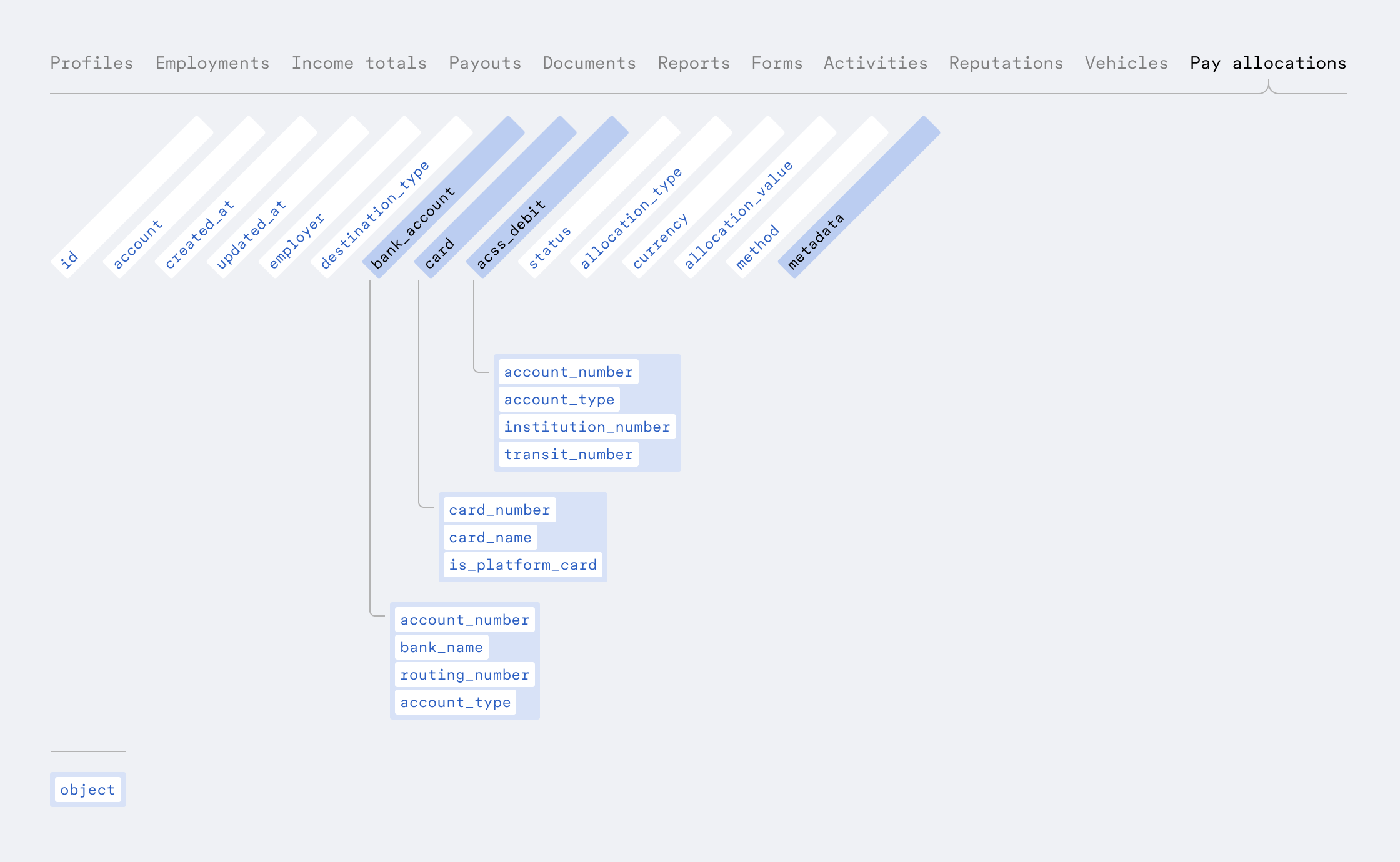
The pay allocation object
Possible values:
Possible values:
Attributes
id(string (uuid), optional): Unique ID of the pay allocation.account(string (uuid), optional): ID of the payroll account associated with a Link item that generates the payout to the user.employer(string, optional): The company or entity that employs the user.destination_type(string (enum), optional)status(note, optional)account_number(string, optional): 5 to 17-digit code that identifies the user as the account holder in the bank. In most cases, the account number will be 8-17 digits long. Depending on the payroll provider, the value can be fully or partially obfuscated.bank_name(string, optional): Represents the bank’s name on the account.routing_number(string, optional): 9-digit code that is based on the bank location where the user’s account was opened. Depending on the payroll provider, the value can be fully or partially obfuscated.card_number(string, optional): Represents the card number.card_name(string, optional): Represents the card’s name on the account.account_number(string, optional): 7 to 12-digit code that identifies the user as the account holder in the bank. Depending on the payroll provider, the value can be fully or partially obfuscated.account_type(string, optional): The type of the user’s bank account.institution_number(string, optional): 3-digit code that identifies the user’s bank.transit_number(string, optional): 5-digit code that identifies the bank’s specific branch where the user holds their account.metadata(object, optional): Holds additional available, often unstructured information about this data resource.
Retrieve a pay allocation
GET/v1/pay-allocations/{id}
- Retrieve a pay allocation object with the supplied ID.
- This request returns a pay allocation object if you provided a valid identifier.
- See Pay allocations for descriptions of all fields in the object.
Path parameters
id(string (uuid), required): The identifier of the pay allocation to be retrieved.
- curl
- python
List pay allocations
GET/v1/pay-allocations
- List all pay allocation objects.
- This request returns an object with a
resultsproperty that contains an array of up tolimitpay allocation objects.
Query parameters
- curl
- python